Last updated November 18, 2026
The Complete Room Addition Contractor Guide for North Las Vegas Homeowners
Most homeowners assume every contractor in the Las Vegas Valley pulls permits from the same office. That’s wrong, and it’s an expensive mistake. North Las Vegas has its own building department, separate from Clark County’s, and contractors who don’t know the difference routinely pull the wrong permit. The project then sits frozen for weeks while everyone blames everyone else. This guide maps the actual North Las Vegas process from first call to final inspection: how permitting really works here, what a written contract has to contain, the inspection sequence between each trade, how to check a Nevada State Contractors Board license, and the caliche soil conditions that quietly inflate foundation costs. Read it before you sign anything.
Quick Answer
Hiring a room addition contractor in North Las Vegas means confirming three things before you sign: the contractor pulls permits through the City of North Las Vegas Building Department (not Clark County), the price is fixed in writing before any work starts, and the contract includes a written workmanship guarantee. A qualified contractor also knows the local caliche soil, the subdivision HOA overlays, and the inspection sequence that keeps a 400-square-foot addition moving instead of stalled. Get those right and the rest is execution.
Table of Contents
- City of North Las Vegas vs. Clark County: Why the Permit Office Matters
- What a Written, Fixed-Price Contract Must Include
- The Sequence of Trades and the Inspections Between Each Phase
- How to Verify a Nevada State Contractors Board License and Insurance
- Caliche Soil and HOA Overlays: Red Flags Specific to North Las Vegas
- What Room Additions Actually Cost in North Las Vegas
- How to Choose a Contractor Without Getting Burned
City of North Las Vegas vs. Clark County: Why the Permit Office Matters
Here’s the fact that trips up out-of-area builders: North Las Vegas is not Clark County. The City of North Las Vegas runs its own building department, with its own submittal requirements, its own plan reviewers, and its own inspection scheduling. A contractor who’s built a hundred additions in Henderson or Summerlin may have never filed a permit in North Las Vegas. When they file through the wrong jurisdiction, the application gets rejected, the plan review clock restarts, and your project is stuck.
What a qualified contractor does at this stage:
- Confirms your address falls under City of North Las Vegas jurisdiction, not unincorporated Clark County. Addresses near the I-215 beltway and properties on the outer edges of the city can straddle lines, and it has to be verified, not assumed.
- Pulls the building permit, electrical permit, and mechanical permit through the correct office. A room addition almost always needs all three.
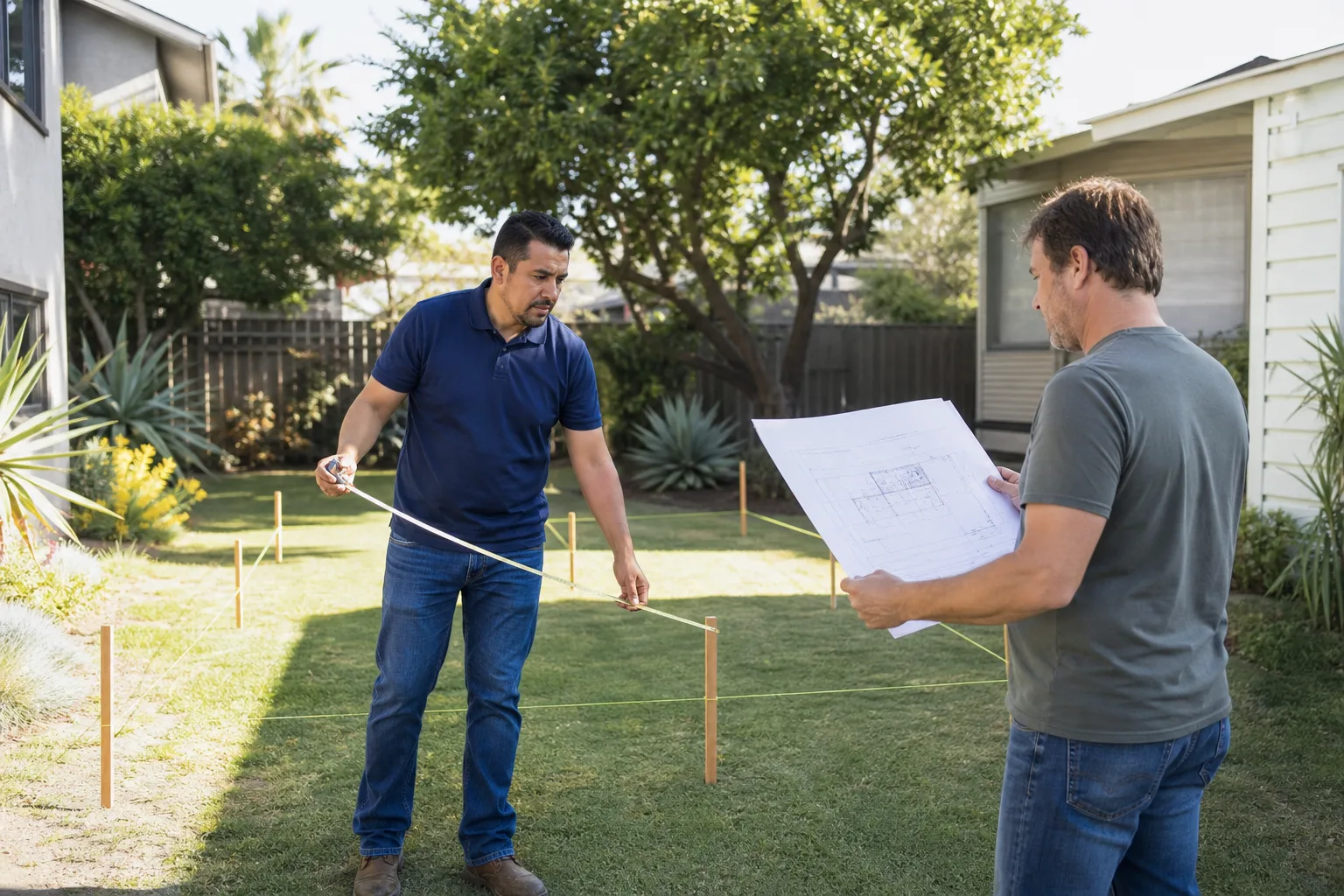
- Submits plans that match North Las Vegas’s current submittal checklist. Two copies of structural plans, a site plan with setbacks marked, and an energy compliance form are typical requirements, but the checklist changes. The contractor checks it, they don’t guess.
The practical consequence: ask any contractor you interview which building department they file with for your address. If they hesitate or say “Clark County, same thing,” keep interviewing. In our experience, that single question filters out more problems than any reference check.
What a Written, Fixed-Price Contract Must Include
A verbal quote is not a price. It’s a starting point for negotiations that happen after your walls are open. The single most common complaint we hear from North Las Vegas homeowners is a number that moved at the door. The remedy is a written contract signed before a single nail is driven, and it needs to include specific items.
Every room addition contract should spell out:
- The full fixed price for the scope as drawn, stated as one dollar amount, not a range with contingencies buried in a footnote.
- The exact scope of work: square footage, wall heights, window and door counts and sizes, finish materials by brand and model. “Standard finishes” is not a scope.
- What’s excluded, written plainly. Landscaping repair, pool relocation, and HOA fees are common exclusions. You should see them named.
- The permit and inspection responsibility. Who pulls permits, who pays the fees, who meets the inspector on site.
- The written workmanship guarantee, with the term in days, what it covers, and how a correction gets scheduled.
- A payment schedule tied to milestones, not to calendar dates. You pay for completed, inspected phases, not for promises.
Under The Garrison Standard, Fielding ADU Builders hands over a written price before any work starts, every time, with no exceptions. The number you approve on day one is the number on the final invoice. If your contractor won’t put a fixed number in writing, you don’t have a price. You have a rumor.
The Sequence of Trades and the Inspections Between Each Phase
Additions stall for a predictable reason: an inspection wasn’t called or wasn’t passed before the next trade covered the work. Understanding the sequence lets you ask the right question at the right time.
- Site prep and foundation. Excavation, forms, rebar, and pour. The foundation inspection happens after rebar is placed but before concrete goes in. Once concrete is poured, nobody can inspect what’s underneath.
- Framing. Walls, roof structure, and sheathing. The framing inspection checks stud spacing, headers, and tie-downs to North Las Vegas wind requirements before anything is covered.
- Rough MEP. Rough plumbing, rough electrical, and rough mechanical run through the open walls. These are typically three separate inspections, and each must be signed off before insulation.
- Insulation. Wall and ceiling insulation, inspected for correct R-value and coverage. North Las Vegas summers make a shortcut here expensive in energy bills for the life of the addition.
- Drywall. Hang, tape, and finish. No inspection between, but this is where sloppy work becomes visible forever.
- Final finishes and trim. Cabinets, flooring, paint, fixtures, and exterior siding. We work with James Hardie siding on conventional additions because it holds up to the desert sun and the summer monsoon cycles.
- Final inspection. The building department signs off on the completed structure, and the permit is closed.
Any contractor who can’t name the inspections in that order isn’t managing the project. They’re reacting to it.
How to Verify a Nevada State Contractors Board License and Insurance
Nevada licenses contractors through the Nevada State Contractors Board, and the license is public record. Check it before you sign anything. This takes about ten minutes and prevents most of the disasters we hear about.
Steps to verify:
- Ask the contractor for their Nevada State Contractors Board license number in writing. A licensed contractor gives it without hesitation.
- Look the number up on the Nevada State Contractors Board website. Confirm the license status is active, the classification matches residential construction, and the name on the license matches the name on your contract.
- Ask for a certificate of general liability insurance and confirm the policy is current, not expired. Ask whether workers’ compensation coverage is in place, and get it documented.
- Confirm the contract is being signed in the same company name that holds the license. A contract signed under a different name is a red flag worth walking away from.
Our crews are background-checked and uniformed, so you know exactly who is on your site, and every call reaches a live person around the clock. Those details matter, but they don’t replace the board check. Do both.
Caliche Soil and HOA Overlays: Red Flags Specific to North Las Vegas
Two local conditions catch out-of-area builders again and again, and both hit your budget.
Caliche. Much of the soil across North Las Vegas contains caliche, a naturally cemented layer that’s closer to concrete than to dirt. A foundation crew that’s never hit it will bid a standard excavation and then ask for more money when the digging stalls. A contractor who knows the area asks about soil conditions before quoting or builds a caliche allowance into the written price from the start. If a bid looks suspiciously low, ask directly how they’re handling caliche.
HOA overlays. Many North Las Vegas subdivisions carry HOA architectural rules on top of the city permit. Setbacks, fence heights, exterior colors, and even roof pitch can be dictated by the HOA. The construction term is setback variance, the city’s written permission to build closer to the property line than the standard rule allows. If your addition needs a variance, that’s a separate approval that runs on its own timeline, and your HOA review runs on another. The contractor should tell you which approvals apply before the contract is signed, not after.
These aren’t rare exceptions. In our experience working in North Las Vegas, they’re the normal conditions. A local contractor expects them. An out-of-town one discovers them at your expense.
What Room Additions Actually Cost in North Las Vegas
Prices vary by size, foundation complexity, and finish level, but homeowners deserve real ranges before they call. Here are typical ranges for a straightforward room addition in North Las Vegas, excluding land, HOA fees, and major site surprises:
- 400-square-foot addition, standard finishes: roughly $95,000 to $130,000, before permit fees.
- 600-square-foot addition, standard finishes: roughly $140,000 to $190,000.
- Caliche remediation allowance: a contractor who knows this soil will build an allowance into the written price. Ask for the number in writing.
- Permit fees: paid to the City of North Las Vegas, based on valuation and scope. The contractor should itemize them in the contract.
Numbers depend on how you build. Prefab and modular platforms like Boxabl and Plant Prefab can change the cost profile of a backyard structure, and we’re fluent in matching the right build method to your lot and budget. If you’re exploring a smaller footprint, our guide to ADU Builders in North Las Vegas covers the accessory dwelling option in detail. Whatever the scope, the price goes in writing before work starts. That’s the whole point.
How to Choose a Contractor Without Getting Burned
You’ve already been through a contractor who missed the schedule or moved the price. The goal this time is a contractor who shows up in the window, prices in writing, works by the book, leaves it clean, and stands behind the work for a year. Those are the standards, in plain terms, and they’re checkable.
What to ask every contractor you interview:
- Which building department will file my permit, and can I see the submittal?
- Will you give me a fixed price in writing before any work starts, and does it include caliche handling?
- What does your written guarantee say, and for how many days?
- Is your crew background-checked and uniformed?
- Can you name the trades and inspections in order, and who meets the inspector on site?
If a contractor can’t answer every one of those in a first conversation, or can’t put the answers in writing, that’s your signal. The Room Addition Contractor in North Las Vegas page lays out how we handle each step, from permit filing to final inspection.
Common Mistakes to Avoid
- Accepting a verbal quote. Verbal quotes are where change orders are born. The price on day one becomes a different number by week six, and you have no written record of what you agreed to. Get it in writing before work starts.
- Assuming your address is in Clark County. North Las Vegas runs its own building department. Filing through the wrong jurisdiction freezes your project for weeks. Verify which office handles your permits.
- Skipping the Nevada State Contractors Board check. A license number that isn’t verified is just a claim. Look it up, confirm it’s active, and match the name on the license to the name on your contract.
- Not asking about caliche. If a bid looks too low, it probably assumes no rock in the dirt. A contractor who knows North Las Vegas asks about soil or builds an allowance into the written price.
- Overlooking HOA architectural review. Subdivision rules can dictate setbacks, colors, and fence heights on top of the city permit. Skipping that review can stop work after the foundation is poured.
- Paying by calendar date instead of milestone. Payments tied to dates reward delays. Payments tied to completed, inspected phases keep the project moving.
- Skipping the written guarantee. A handshake that “we’ll make it right” is worth nothing on paper. Get the guarantee term and terms in writing.
When to Call a Professional
Some things should never be a weekend project. Call a professional when the work involves any of the following: structural changes that alter load paths, moving or adding electrical circuits and panels, running plumbing through a foundation or slab, gas line work, or anything that requires a permit to be legally built and signed off. Roof work and anything over head height counts too. Beyond safety, the moment you start sketching a room addition on graph paper with a permit in mind, that’s a contractor conversation. Run your electrical or gas lines yourself and you risk injury and an unpermitted structure that can’t be financed or insured later. Fielding ADU Builders offers free estimates in North Las Vegas. Call (844) 797-5166 and get a fixed price in writing before anything starts.
Frequently Asked Questions
Yes. Any addition that adds square footage or changes the structure requires a building permit from the City of North Las Vegas Building Department, plus electrical and mechanical permits. Filing through Clark County when your address belongs to the city will get the application rejected. Confirm which office has jurisdiction, then plan for the inspection sequence before work begins.
A standard 400-square-foot addition typically runs roughly $95,000 to $130,000 before permit fees, and a 600-square-foot addition roughly $140,000 to $190,000. Caliche soil and finish level move the number. A written, fixed price before work starts is the only way to know your actual cost. Call (844) 797-5166 for an exact quote; estimates are free.
It shouldn’t. With a written fixed-price contract, the number you approve on day one is the number on the final invoice. The exception is work deliberately excluded from the original scope, which is why the contract has to list exclusions. Ask for caliche handling to be priced in upfront so it doesn’t become a surprise line item.
A typical 400- to 600-square-foot addition takes roughly four to six months from signed contract to final inspection, and permit review is often the longest stretch. City of North Las Vegas plan review, caliche remediation, and HOA approvals can each add time. Your contractor should give you a schedule in writing and explain what could move it.
Ask for the Nevada State Contractors Board license number in writing, then look it up on the board’s website. Confirm the license is active, the classification covers residential construction, and the name matches your contract. Then ask for current general liability insurance and documented workers’ compensation coverage, and confirm they’re not expired.
A room addition builds new conditioned square footage, while a garage conversion reworks existing structure into living space. Both need permits, but the costs and timelines differ. Our page on Garage Conversion Contractor in North Las Vegas covers the conversion path, and moving up to the full guide on the Fielding ADU Builders North Las Vegas home page shows how we scope both options.
The Bottom Line
Hiring a room addition contractor in North Las Vegas comes down to five checks. Confirm the contractor files with the City of North Las Vegas Building Department, not Clark County. Get a fixed price in writing before any work starts. Verify the Nevada State Contractors Board license and insurance. Ask how caliche and HOA overlays are handled in the written price. And read the written workmanship guarantee before you sign. Do those five things and you’ll avoid the change orders, the frozen permits, and the contractor who disappears mid-project. The right contractor answers all of it without being asked twice.
Fielding ADU Builders is an independently owned and operated member of the Garrison Partners family, founded in 2006, specializing in ADU construction, garage conversions, and room additions. Every project receives a written price before any work starts and is covered by a written one-year guarantee; if workmanship fails within that period, we return and correct it at no charge. Call (844) 797-5166 for a free estimate. A live person answers around the clock.
Written by the team at Fielding ADU Builders North Las Vegas.