Last updated November 18, 2026
Room Addition Contractor Warning Signs Every Homeowner Should Know
The contractor who gives you the fastest verbal quote is usually the one who hasn’t done the site measurement to know if that quote is real. And when his materials cost comes in higher than he guessed, that gap becomes your problem, not his. In our experience working room additions and ADU projects across North Las Vegas, the behaviors that predict a bad build show up weeks before the first wall goes up. That’s the part most homeowners miss. They’re comparing bid numbers while the process signals slide by unchecked. This guide names the specific warning signs to watch for before you sign, why each one matters, and what to do instead.
Quick Answer
The clearest warning signs of a bad room addition contractor are: a fast verbal quote with no site measurement, resistance to pulling permits, a vague or open-ended scope of work, a request for 50% or more upfront, and a license you haven’t verified. These process failures appear before the contract is signed, and they reliably predict how a contractor behaves when something goes wrong mid-build. Price tells you what a job costs. Process tells you whether the job gets finished.
Table of Contents
- 1. The Fast Verbal Quote With No Site Measurement
- 2. Why a Contractor Who Discourages Permits Isn’t Saving You Money
- 3. What a Vague Scope of Work Really Means in Practice
- 4. Verifying a License in Under Five Minutes on the Nevada State Contractors Board
- 5. The Large-Deposit Red Flag and What a Fair Draw Schedule Looks Like
- 6. How to Read Review History for Pattern Problems, Not Star Ratings
- 7. The Soft Signals: Communication, Crew, and Clean Sites
The Fast Verbal Quote With No Site Measurement
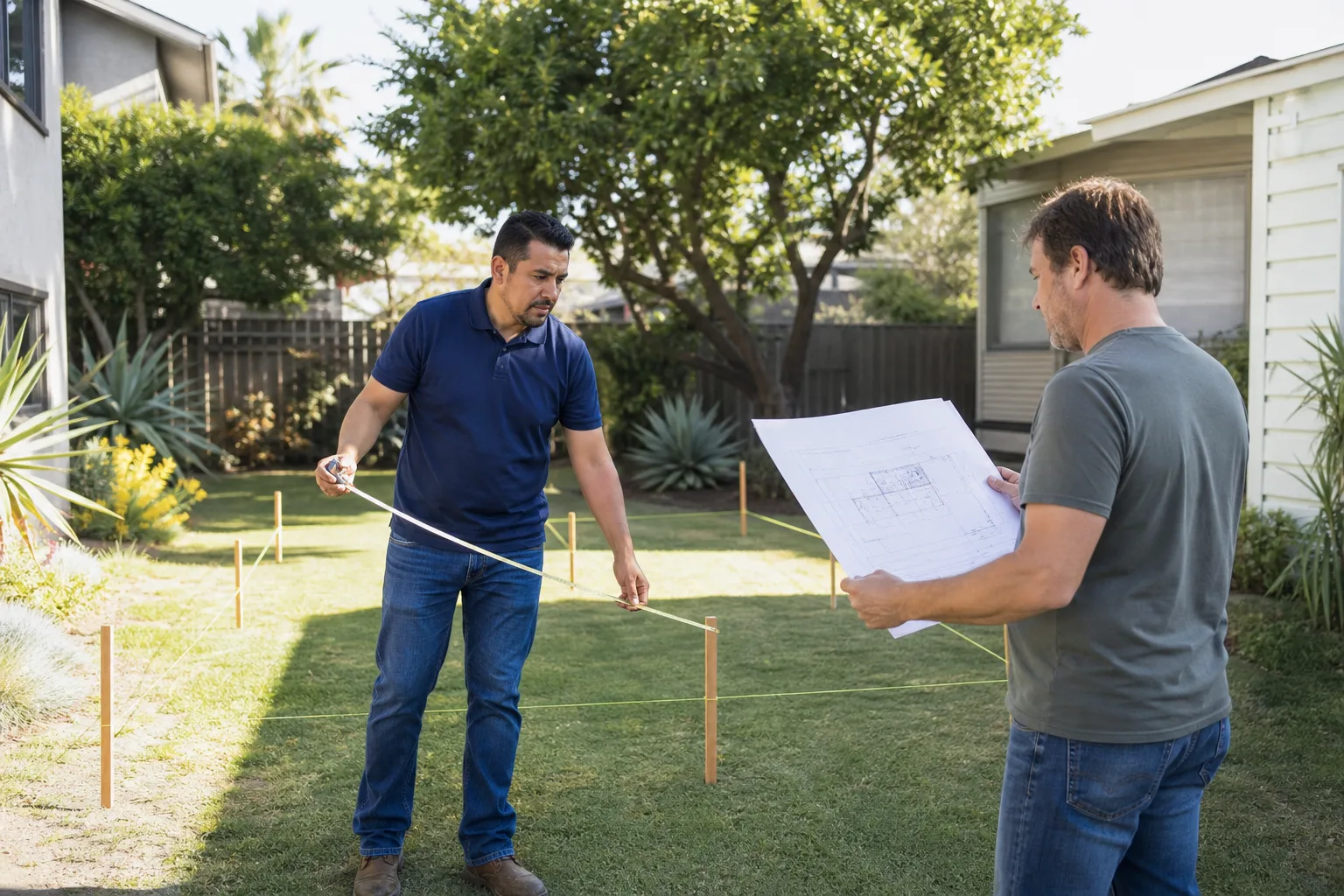
A real room addition quote starts with someone walking your property. Setbacks, grade, utility locations, roofline tie-ins, and access all move the number, and none of them can be read from a photo or a phone call. When a contractor hands you a firm figure before measuring anything, they’re guessing. That guess is usually low, and the correction lands on you as a change order once materials are ordered.
We’ve seen this repeatedly in North Las Vegas, where lots vary significantly in size, alley access, and existing utility placement. Two houses on the same block can carry completely different foundation costs because of what’s underground. A quote built without eyes on the site can’t account for that.
What a real site visit looks like:
- Someone measures the actual build footprint and checks property lines against the lot survey.
- They note the existing foundation type and where it meets the new slab.
- They flag utilities, drainage, and access constraints in writing.
- They confirm setbacks against the zoning for your parcel, not a generic rule of thumb.
If a contractor can’t tell you what your setbacks are before quoting, they haven’t done the work required to price the job honestly. Our own process puts the price in writing before any work starts, and it starts with a measured site visit, every time.
Why a Contractor Who Discourages Permits Isn’t Saving You Money
The most expensive warning sign is a contractor who tells you the permit is unnecessary or will “just slow things down.” An unpermitted room addition is a liability you carry indefinitely. Here’s what it actually costs:
- Resale. An unpermitted addition usually surfaces during a buyer’s inspection. You either pay to legalize it retroactively or discount the sale to cover the risk. In a North Las Vegas resale, buyers and their agents ask for permit history on any square footage added to a home.
- Insurance. Most policies exclude or limit coverage on unpermitted work. If a fire or water loss originates in that space, the claim can be denied.
- Safety. Electrical, structural, and life-safety requirements exist for a reason. Skirting inspection means no one verified the framing, wiring, or egress.
- Code enforcement. North Las Vegas code enforcement can require you to open walls or halt use of the space if work is reported or discovered.
The short-term “savings” from skipping a permit is a fraction of the long-term exposure. A legitimate contractor builds by the book because the book is what protects the value of your home. The Garrison Code we operate by is blunt on this point: permitted work, done to code, inspected. No shortcuts.
If you’re weighing whether a room addition or a garage conversion in North Las Vegas better fits your lot and budget, both require permits. The difference is scope and how much of the existing structure you’re allowed to reuse.
What a Vague Scope of Work Really Means in Practice
A contract that says “standard materials” or “as needed” without defining them is not a scope of work. It’s a container for future change orders. When the language is loose, the contractor controls the interpretation, and each interpretation has a price attached. Homeowners discover this the week the change order arrives.
Vague scope language you should push back on:
- “Standard materials” without brand, grade, or model numbers named.
- “As needed” for electrical, plumbing, or structural items with no allowance figure.
- No mention of who pulls the permit and who pays for it.
- No schedule with milestones or completion dates.
- No written warranty terms, only a verbal promise.
A line-item scope names the actual products. For example, if exterior siding is part of your addition, a specific name like James Hardie should appear in the spec, not a generic “fiber cement.” If you’re building a detached unit through a prefab platform like Abodu, Cover, or Dvele, the contract should name the platform, the model, and what’s included versus excluded in the site work.
Here’s the practical fix: ask the contractor to hand you a written price before any work starts. If they can’t or won’t, that tells you how the change orders will go later. Our written-price-first policy exists because that single line of the contract prevents the most common dispute in the trade.
Verifying a License in Under Five Minutes on the Nevada State Contractors Board
You don’t need construction experience to verify a contractor. You need the Nevada State Contractors Board website and five minutes. Every licensed contractor in Nevada appears there with a license number, expiration date, classification, and complaint history. Skipping this step is the single most avoidable mistake a homeowner makes.
- Get the license number in writing from the contractor, not from their website. It should be on the bid and the contract.
- Search it on the Nevada State Contractors Board site. Confirm the name matches the company you’re hiring, not a related entity.
- Check the classification. A license for one type of work doesn’t automatically cover a room addition. Confirm the classification matches the scope.
- Confirm the expiration date. A license past expiration isn’t a license. Neither is one listed as suspended or with restrictions.
- Read the complaint record. Look for resolved complaints, unresolved complaints, and how recently they occurred. One old complaint is not a dealbreaker; a pattern is.
An expired license means the contractor’s bond and insurance may also have lapsed, which shifts liability to you if something goes wrong. A restricted license can mean the board limited the types of jobs the contractor is allowed to take. If either appears, walk away. The five minutes you spend here is cheaper than the alternative. When you’re ready to compare bids on a room addition contractor in North Las Vegas, a license number should be on every document you’re handed.
The Large-Deposit Red Flag and What a Fair Draw Schedule Looks Like
A reputable contractor does not need 50% upfront. A large deposit is a signal that the contractor is funding your job from your money, which means if cash flow tightens, your job is the one that stalls. The homeowners who get burned by deposits are usually the ones who paid the most, the earliest.
What a reasonable draw schedule looks like on a room addition:
- A modest initial deposit to secure materials and start scheduling.
- Progress draws tied to completed, inspectable milestones: foundation, framing, rough-in, drywall, finishes.
- Final payment held until the job is finished and inspected, with a written punch list closed out first.
- No payment in advance of work that already happened. You pay for what’s done, not what’s promised.
Ask the contractor to put the draw schedule in writing alongside the scope. If they can’t explain why each draw falls where it does, or if they insist on front-loading the schedule, that’s your answer. The Garrison Standard, the written commitment our organization holds itself to since 2006, puts the price in writing before any work starts. That includes the draw schedule. We don’t ask for money for work that hasn’t happened.
How to Read Review History for Pattern Problems, Not Star Ratings
Star ratings are close to meaningless on their own. A review pattern tells you far more. What you’re looking for is whether the negative reviews repeat the same complaint. If five different reviews mention the same issue, price surprises, missed schedules, unresponsive office, that’s not a personality clash. That’s a system.
How to read a review history properly:
- Start with the lowest-rated reviews and read them in full. Skim the five-star ones last.
- Group complaints by theme. Look for repeated issues: cost overruns, permit problems, communication gaps, unfinished punch lists.
- Check the dates. A cluster of complaints in the same six-month window tells you more than scattered complaints over years.
- Read the responses. How a contractor responds to a bad review, in public, tells you how they’ll handle your complaint behind closed doors.
- Cross-check across platforms. Google, Yelp, BBB, and Angi each catch different customers. A pattern only shows up when you look at more than one.
In North Las Vegas, where room additions and ADUs are growing in demand, some contractors take on more work than they can staff. A pattern of schedule complaints is the earliest sign of that. Ours is a plain accounting: if the reviews show repeated late finishes, the job you’re about to sign is the next one on that list.
The Soft Signals: Communication, Crew, and Clean Sites
The behavioral signals that don’t show up on paper often predict the job outcome better than anything else. A contractor who answers his phone during the bidding phase will answer it during the build. One who leaves you in voicemail for a week won’t suddenly become reachable once they have your deposit.
Signals worth weighting:
- Who answers the phone. If a live person picks up at noon and at midnight, the communication channel is real. Live phone coverage around the clock is one of the cheapest indicators of how a company is run.
- Who shows up. Background-checked, uniformed crews are a baseline, not a perk. If you can’t confirm who will be on your property, that’s a process gap. Every crew member on our jobs is verified before they set foot on site.
- How the site looks. A crew that leaves the yard clean at the end of the day is a crew that pays attention. Trash and material staging are the easiest things to keep straight, and the first to slide.
- What happens after delivery. A full year of written guarantee is the load-bearing element of confidence. If the work fails inside that year, the contractor returns and makes it right at no charge. Without that in writing, you’re relying on goodwill after the final invoice is paid.
Our technicians bring up to 20 years of experience each, and the crews are the same regardless of job size. That consistency is the piece homeowners can check on before signing. Fielding ADU Builders North Las Vegas holds to the same standard our parent organization has carried since its founding in 2006: show up in the window, price in writing, by the book, leave it clean, stand behind it for a year.
Common Mistakes to Avoid
- Choosing the lowest bid without reading the scope. The lowest number usually hides the largest allowances. Compare line items, not totals. In North Las Vegas we’ve seen bids 30% apart that only differed in what they didn’t include.
- Skipping the license check. The Nevada State Contractors Board site takes five minutes. Homeowners who skip it discover the problem when a complaint arises and the license has already lapsed.
- Paying a large deposit before the contract is signed. If you’re being asked for a deposit before the paperwork is done, that’s a warning sign, not an incentive. Get the signed contract and draw schedule first.
- Not walking the site with the contractor before signing. A quote without a site visit is a guess dressed as a price. Insist on the walkthrough.
- Accepting a verbal warranty. “We stand behind our work” isn’t a warranty. Ask for the terms in writing: what’s covered, how long, and how a claim gets made.
- Assuming prefab is automatically cheaper or more expensive. Detached ADUs on platforms like Mighty Buildings or Cover vary widely in the site-work portion of the cost. Get a written breakdown of platform and site costs separately, since the platform price alone tells you very little. If an ADU in North Las Vegas is the better fit for your situation than a room addition, we price both the same way.
- Not asking who pulls the permit. If it isn’t in the contract, it might land on you, and the inspection timeline and the cost both follow whoever signs as the applicant of record.
When to Call a Professional
If any single red flag on this list is present in the contractor you’re considering, that’s a call. If two or more are present, walk away and restart the process. The most common scenarios where our clients reach out: they’ve just been told the permit isn’t needed, they’ve received a verbal quote with no line items, they’ve been asked for a deposit above a third before the contract was signed, or they’ve been ghosted for a week after receiving a bid. In each case, a second opinion costs nothing and prevents a substantially larger bill later. Fielding ADU Builders North Las Vegas offers free estimates in North Las Vegas. Call (844) 797-5166 to schedule a site visit and get a written price you can compare against the bid you already have.
Frequently Asked Questions

Room addition costs in North Las Vegas typically run from a few hundred dollars per square foot for simpler bump-outs to higher per-square-foot figures for full structural additions with plumbing and electrical. The final number depends heavily on lot conditions, foundation type, and finish level, and North Las Vegas’s expansive soils mean foundation work can vary meaningfully from one parcel to the next. Call (844) 797-5166 for an exact quote after a site visit; estimates are free.
Search the license number on the Nevada State Contractors Board website and confirm the classification matches your scope of work, the license hasn’t expired, and there are no unresolved complaints. Ask for the number in writing so the search matches the entity billing you. Anything short of a valid, current license with the right classification is a reason to pass.
A modest initial deposit is normal; 50% or more upfront is not. Reasonable schedules tie progress payments to completed, inspectable milestones, with final payment held until the punch list is closed. If the contractor can’t put the draw schedule in writing alongside the scope of work, that’s a problem worth pausing on.
No. Any structural addition to a home requires a permit in North Las Vegas, regardless of size. Unpermitted square footage creates resale, insurance, and code enforcement exposure that far exceeds the permit cost. A contractor who tells you otherwise is telling you how they operate.
A simple addition runs longer than most homeowners expect, and the timeline depends on scope, permitting, and inspection scheduling in North Las Vegas. A written schedule with milestones is part of a proper scope of work. If the contractor can’t produce one before you sign, the timeline you’re being given verbally is a guess.
A real guarantee is specific: what’s covered (typically workmanship defects), how long (a full year), and how a claim gets handled. The Garrison Standard covers workmanship defects for 365 days; if something fails, we come back and make it right at no charge. Ask any contractor you’re considering to show you those terms in writing before signing.
The Bottom Line
The warning signs that predict a bad room addition experience almost always show up before the contract is signed, and they’re about process, not price. A fast quote without a site visit, resistance to permits, loose scope language, a 50% deposit request, an expired license, and reviews with a repeated complaint all point to the same outcome. Homeowners who check those six things before signing are the ones who finish the build on schedule and on budget. Everything else, the number on the page, the brand names in the spec, the timeline, is downstream of the process. If you want a second set of eyes on a bid you’ve already received, call (844) 797-5166 for a free estimate, and we’ll put the price in writing before any work starts.
Written by the team at Fielding ADU Builders North Las Vegas.