Last updated November 18, 2026
ADU Warning Signs: A North Las Vegas Homeowner’s Reference Guide
A hairline crack in stucco is not automatically a structural problem. A hairline crack at the corner of a window opening that widens after a rain event is a different conversation. Knowing the difference saves homeowners from both panic and from ignoring the wrong thing. In North Las Vegas, where expansive soils, monsoon rain, and 110-degree summers work on a building year-round, small warnings show up early. This guide names what you’re looking at: the stucco patterns, the HVAC sounds, the slow drains, the tripping breakers, and the sticking doors that tell you something in your accessory dwelling unit needs attention before it gets expensive.
Quick Answer
Most ADU problems in North Las Vegas give visible warnings weeks before they turn expensive. Cosmetic stucco shrinkage cracks run randomly and stay narrow; diagonal cracks at window or door corners that widen after rain mean movement. Short-cycling or uneven cooling points to a strained HVAC system, slow drains point to scale or pipe aging, and doors that suddenly bind point to slab settlement. None of these are reasons to panic. All of them are reasons to get an inspection and a written diagnosis before the repair cost multiplies.
Table of Contents
- Stucco Cracking: Cosmetic Versus Structural
- HVAC Warning Signs in a Desert Climate
- Plumbing Early Warnings: Slow Drains and Caliche Soil
- Electrical: Tripping Breakers That Reset Versus Ones That Don’t
- Foundation and Slab: Binding Doors and Windows
- Warning Signs by Build Method: Stick-Built Versus Prefab
- Common Mistakes to Avoid
- Frequently Asked Questions
Stucco Cracking: Cosmetic Versus Structural
Stucco is the most common exterior finish on North Las Vegas ADUs, and it cracks. That’s normal. Three-coat stucco over lath cures, dries, and shrinks, and in a climate that swings from 40 degrees overnight to 105 by afternoon, the finish moves with the wall. The question isn’t whether you’ll see cracks. It’s which kind you’re seeing.
Cosmetic shrinkage cracks are the good news, relatively speaking. They’re hairline, less than 1/16 inch wide, they run in short irregular lines, and they don’t follow any obvious pattern around openings. They typically show up in the first two years after installation and then stabilize. They’re a maintenance item, not a structural signal.
Movement cracks are the ones that need a look. In our experience, the pattern to watch is a diagonal crack that runs from a corner of a window or door opening out toward the ceiling or floor. Concrete and masonry openings are stress concentrators; when the wall behind the stucco moves, the crack telegraphs to the corner and runs diagonally. Two things make it worth a call:
- It widens after a rain event. Monsoon moisture in North Las Vegas can penetrate a finish crack, swell the soil under a footing, and then shrink again. A crack that visibly gets wider in the days after rain is telling you the ground is moving.
- It’s wider than a credit card edge. Roughly 1/8 inch is the threshold where it’s time to stop watching and start testing.
- It’s mirrored on the interior drywall at the same corner. Exterior and interior cracks at the same opening is a stronger signal than either alone.
Don’t fill a movement crack with caulk and forget it. That hides the evidence without fixing the cause, and the next rain event tells you nothing. Get it looked at, get the cause named, then repair. If you’re wondering whether it’s time to rebuild rather than repair, our page on ADU builders in North Las Vegas covers what a replacement involves.
HVAC Warning Signs in a Desert Climate
An ADU sits behind the main house, often on a separate small system, and it works harder than you think. A 500- to 800-square-foot unit has a small load, which means the equipment is small, which means it has less margin for error. Three signs matter most in North Las Vegas.
Short-cycling
If your ADU air conditioner kicks on and off every few minutes, it’s short-cycling. The unit never runs long enough to remove humidity (what little there is) or to settle into an efficient cycle, and the compressor wears faster. Common causes: an oversized system, a low refrigerant charge, a failing capacitor, or a thermostat placed where it reads a wall that’s already hot. It’s also often a duct problem disguised as an equipment problem. Short-cycling is one of the most common complaints we hear about North Las Vegas ADUs in their first summer.
Uneven cooling between the ADU and the main house
If the main house hits 74 and the ADU sits at 82, the problem is usually distribution, not the condenser. Small units are sensitive to duct design, and prefab platforms like those from Plant Prefab and Boxabl ship with their own mechanical plan that a general installer sometimes fumbles. The right answer is a proper load calculation and a duct check, not a bigger unit.
Condensate drain backup
Every ADU has a condensate line that carries water away from the air handler. In desert climates, those lines run through hot attic or mechanical closet space and can clog with dust and algae. When the line clogs, water backs up into the pan, and if the pan switch fails, you get water damage in the wall. Check the pan and the drain quarterly. If you see standing water or the pan is rusting, stop running the system and get it looked at.
Plumbing Early Warnings: Slow Drains and Caliche Soil
Slow drains get ignored more than any other warning sign, and in North Las Vegas that’s a mistake. A drain that used to empty in seconds and now empties in fifteen is telling you something is building up in the line. Sometimes it’s hair and soap. Sometimes it isn’t.
Most North Las Vegas ADUs are slab-on-grade, which means the drain line is cast iron or PVC buried under the concrete. Under the slab, our local soil matters. Caliche, the calcium-carbonate hardpan common around the valley, is alkaline and can be aggressive to older cast iron over decades. The metal scales on the inside and rusts from the outside where soil chemistry attacks it. A line that’s only partly blocked will drain slowly and then eventually back up, often at the worst time.
Two signs worth a plumber’s camera inspection:
- One fixture drains slow, others are fine. That’s a local blockage, usually near the trap. Often a quick fix.
- Multiple fixtures drain slow, or the toilet gurgles when the sink drains. That’s a main-line issue. Gurgling is a vent or partial blockage signal, and in a slab it’s cheaper to inspect early than to jackhammer later.
If you have a garage conversion in North Las Vegas, the plumbing was likely tied into the existing house main. Know where that tie-in is before you ever have a problem, and know how the conversion was permitted. Our page on garage conversion contractors in North Las Vegas explains what a permitted conversion should include.
Electrical: Tripping Breakers That Reset Versus Ones That Don’t
Modern ADUs are required to have AFCI protection (arc fault circuit interrupters) on most branch circuits and GFCI protection (ground fault) on kitchen, bath, and exterior outlets. These devices trip for a reason. The pattern of the trip tells you which reason.
Trips once, resets and stays on
A single trip that resets cleanly is often a nuisance event: a motor startup, a compressor inrush, a lightning-adjacent surge. If it doesn’t happen again in a week, note it and move on. If it happens again at the same outlet on the same appliance, it’s a pattern, and a pattern means something.
Trips repeatedly, resets and trips again
This is the more serious pattern. In an ADU, an AFCI that trips repeatedly on the same circuit usually means one of three things: a loose connection in a box, a damaged conductor somewhere in the wall, or a failing appliance. A GFCI that trips repeatedly on a bathroom or exterior circuit usually means moisture is getting to a device. Neither is safe to reset and ignore. Repeated tripping is a signal that the circuit needs to be opened and tested, not defeated by swapping in a non-AFCI breaker.
A specific North Las Vegas caution: if an exterior outlet on your ADU trips repeatedly after a monsoon storm, treat it as a moisture intrusion issue, not a nuisance trip. Water is getting somewhere it shouldn’t. Call an electrician. Electrical work is not a homeowner task; the risk of shock and fire is real, and a panel or device that keeps tripping needs a trained professional with test equipment.
Foundation and Slab: Binding Doors and Windows
Binding doors and windows are the single most readable sign of slab movement in a North Las Vegas ADU. A door that closed easily last summer and now sticks at the top corner is telling you that the slab under one side has moved relative to the other. That’s called differential settlement.
Our local soil is the reason. Expansive clay and caliche react to moisture changes, swelling in wet seasons and shrinking in dry ones. In a valley where we can go months without meaningful rain and then get half an inch in an afternoon, the slab edge experiences real movement. A well-built ADU has footings designed for that. A poorly built one doesn’t, and the first thing you notice is the door.
How to read it:
- One door binds, no others. Often humidity or seasonal stick, or a hinge. Check it after a dry week. If it fixes itself, it’s seasonal.
- Multiple doors and windows in the same direction bind. That’s a floor-plane signal. Get a foundation evaluation.
- Diagonal drywall cracks from the top corners of doors and windows combined with binding doors is the strongest combination. That’s not cosmetic.
Get a written diagnosis, not a sales pitch. A proper foundation evaluation involves elevations and a report, and if a repair is needed, the report should say exactly what’s wrong and why. If you’re weighing repair against a rebuild and your addition is attached to the house, our page on room addition contractors in North Las Vegas walks through how attached additions are evaluated.
Warning Signs by Build Method: Stick-Built Versus Prefab
The warnings you should watch for differ depending on whether your ADU is conventional stick-built or a prefab platform like Abodu, Cover, Dvele, Mighty Buildings, Boxabl, or Plant Prefab. Both are legitimate ways to build, and both can fail. The failure modes are different.
For stick-built construction with a finish like James Hardie siding, watch the finish and the caulk lines. Fiber cement siding is durable, but it moves with thermal expansion, and in a North Las Vegas summer the caulk joints at corners and penetrations take a beating. A caulk line that has pulled away from the siding is a water entry point, and water entry behind the siding leads to the sheathing. Check the caulk lines at every corner and around every window and vent annually.
For prefab and modular units, watch the seams where the modules meet and the penetrations where the unit ties into the site work. Plant Prefab and similar platforms arrive engineered, but the site tie-in (foundation, utility connections, roof transitions) is where problems show. A gap at the module joint, a roof flashing that lifts, or a utility penetration with failed sealant on a prefab unit are the equivalent of a stucco movement crack on a stick build.
For small structures like a Tuff Shed-style or boxed ADU, watch for floor deflection and door alignment first. Smaller footprints have less tolerance for foundation imperfection. Call us for a free estimate on a replacement or rebuild if the repair cost starts to approach replacement. Call (844) 797-5166 to schedule that estimate.
Common Mistakes to Avoid
- Caulking and painting over a movement crack. Hiding a crack hides the evidence. It doesn’t fix the cause, and it steals your best warning for next season. If it’s diagonal at an opening, get it evaluated first.
- Resetting a tripping breaker until it “stays on.” A breaker that trips repeatedly is doing its job. Swapping it for a bigger one or a non-AFCI device is the most dangerous shortcut a homeowner can take. Call an electrician.
- Ignoring slow drains in a slab-on-grade ADU because they’re “still draining.” A slow main-line drain is where the jackhammer bill starts. Get a camera inspection at the first gurgle.
- Assuming the ADU needs a bigger AC unit. North Las Vegas ADUs are usually won or lost on duct design and load calculation, not condenser size. An oversized unit short-cycles and wears out faster.
- Treating a prefab ADU’s site ties as a homeowner punch list. Module joints and utility penetrations are engineered connections. They need to be sealed and inspected to spec, not caulked by feel.
- Letting an unpermitted conversion ride. If you bought a property with an unpermitted garage conversion or ADU, the warning signs are also a permit problem. Get it inspected and legalized before you sell or refinance.
- Calling for a full rebuild when you haven’t gotten a written diagnosis. Panic is expensive. A written report that names the cause and the fix is cheaper than a rebuild you didn’t need.
When to Call a Professional
Call a professional when you see any of these: a diagonal stucco crack at an opening that widens after rain, multiple doors and windows binding in the same direction, an AFCI or GFCI breaker that keeps tripping after reset, a condensate pan with standing water, a gurgling main drain, or a prefab module joint that has opened. Each of these has a specific cause and a specific fix, and the earlier you get it diagnosed, the narrower the repair. Call us for a free estimate and a written diagnosis. Fielding ADU Builders North Las Vegas offers free estimates in North Las Vegas. Call (844) 797-5166. Our technicians have up to 20 years of experience, and every crew member is background-checked and arrives in uniform. Start at our Fielding ADU Builders North Las Vegas home page.
Frequently Asked Questions
Cosmetic cracks are hairline, under 1/16 inch, run in short irregular lines, and don’t follow any pattern around openings. Structural movement cracks run diagonally from the corner of a window or door opening and often widen after a rain event. If the crack is wider than 1/8 inch, diagonal at an opening, or mirrored on the interior drywall, get it evaluated. Call (844) 797-5166 for a free estimate.
Uneven cooling is usually a duct or load-calculation problem, not an equipment problem. Small ADU systems are sensitive to duct sizing and thermostat placement. Check the duct runs for leaks, verify the thermostat isn’t on a sun-baked wall, and have a technician run a load check before anyone suggests a bigger condenser. Call (844) 797-5166 for an exact quote on a diagnosis.
Slow drains come from a partial blockage, scale in older cast iron, or a settled line. Caliche soil in the valley is alkaline and can be aggressive to cast iron under the slab over decades. A gurgling toilet when the sink drains is a main-line signal. A camera inspection is the only way to know the cause. Call (844) 797-5166 for a free estimate.
Yes. A breaker that trips repeatedly after reset is signaling a loose connection, a damaged conductor, or a failing appliance. It should be tested, not defeated with a different breaker. Electrical work carries real shock and fire risk, so use a trained electrician. Call (844) 797-5166 for a free estimate.
Seasonal binding that resolves after a dry week is usually humidity and thermal movement, not a failing slab. Binding that gets worse over time, happens in multiple doors and windows in the same direction, or comes with diagonal drywall cracks is a differential settlement signal and needs a foundation evaluation. Call (844) 797-5166 for a free estimate.
Yes. Any repair that touches structure, electrical, plumbing, or gas requires a permit under North Las Vegas code, and a repair that skips the permit board creates a bigger problem on re-sale. Every project we take on is permitted by the book and inspected before we close it out. The Garrison Standard is the way we operate: show up in the window, price in writing, by the book, leave it clean, stand behind it for a year. Call (844) 797-5166 to schedule your free estimate.
The Bottom Line
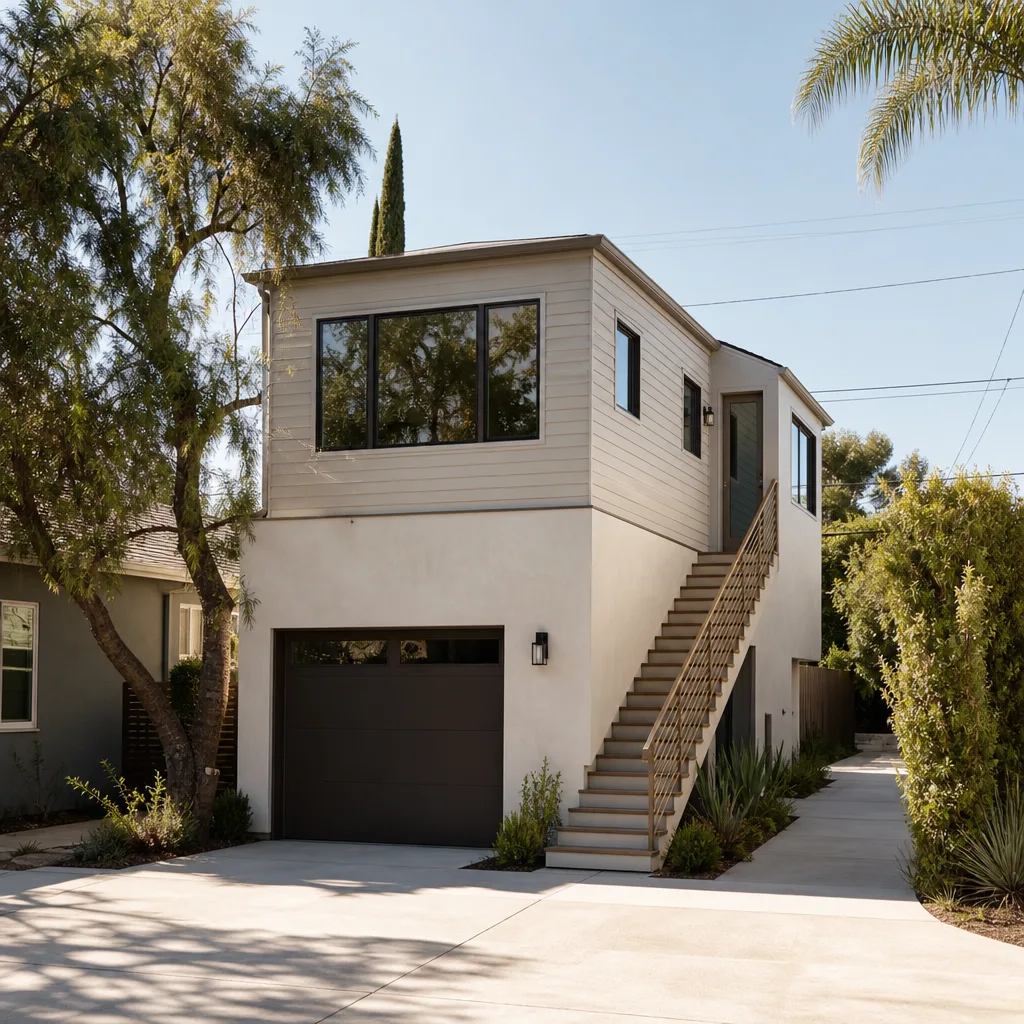
Most ADU problems in North Las Vegas telegraph themselves weeks before they cost real money. A hairline stucco crack is cosmetic. A diagonal crack at a window corner that widens after rain is a movement signal. A short-cycling AC, a gurgling drain, a breaker that keeps tripping, and a door that binds in the same direction as its neighbors are all readable warnings. Your job is to read them and call for a written diagnosis before the fix gets bigger. Fielding ADU Builders North Las Vegas gives you a written price before any work starts and backs every project with The Garrison Standard: a full-year written guarantee that returns at no charge if the work fails. The price goes in writing before a single nail is driven. If a repair isn’t the right answer and a rebuild is, we work with Abodu, Cover, Dvele, Mighty Buildings, Boxabl, and Plant Prefab, plus conventional James Hardie builds, so the method fits the lot and the budget. Call (844) 797-5166 for a free estimate. Someone answers, every hour of every day.
Written by the team at Fielding ADU Builders North Las Vegas.